What is Application Management Services?
Application Management Services (AMS) is a specialized service that takes care of business applications by supporting, maintaining, monitoring, and enhancing them through their lifecycle. Applications are essential for organizations to function for finance, customer management, communication, human resources, supply chain management, e-commerce, analytics, and various other activities. Business productivity may be impacted when these applications suffer performance issues, security concerns or downtime.
AMS offers organizations professional solutions to successfully manage these applications. While some companies are completely dependent on their own IT resources, others can rely on external service providers for application support, maintenance, monitoring, troubleshooting, application upgrade, application optimization, etc.
The objective of Application Management Services isn’t just to resolve issues after they have developed. Today’s AMS strategies also emphasize preventing problems, making applications run faster, assisting users, and keeping applications productive as business needs evolve.
What Makes Application Management Services Important for Businesses?
As businesses expand, the complexity of their application environment may increase as well. You can rely on cloud applications and legacy systems, enterprise software, mobile apps, databases, and custom built platforms all at once. It can take a considerable amount of resources to oversee all of these technologies from within.
Application Management Services can alleviate this complexity by providing organized support and expertise. AMS teams can track applications on an ongoing basis, spot problems, resolve incidents and plan maintenance efforts.
An added advantage is enhanced availability. Staff can continue to function efficiently and customers can access essential services when critical applications are operating. Monitoring and proactive maintenance can help minimize unexpected disruptions for AMS providers. Organizations can also leverage technical experts without building a big in-house team for each application or technology.
What Does Application Management Services Include?
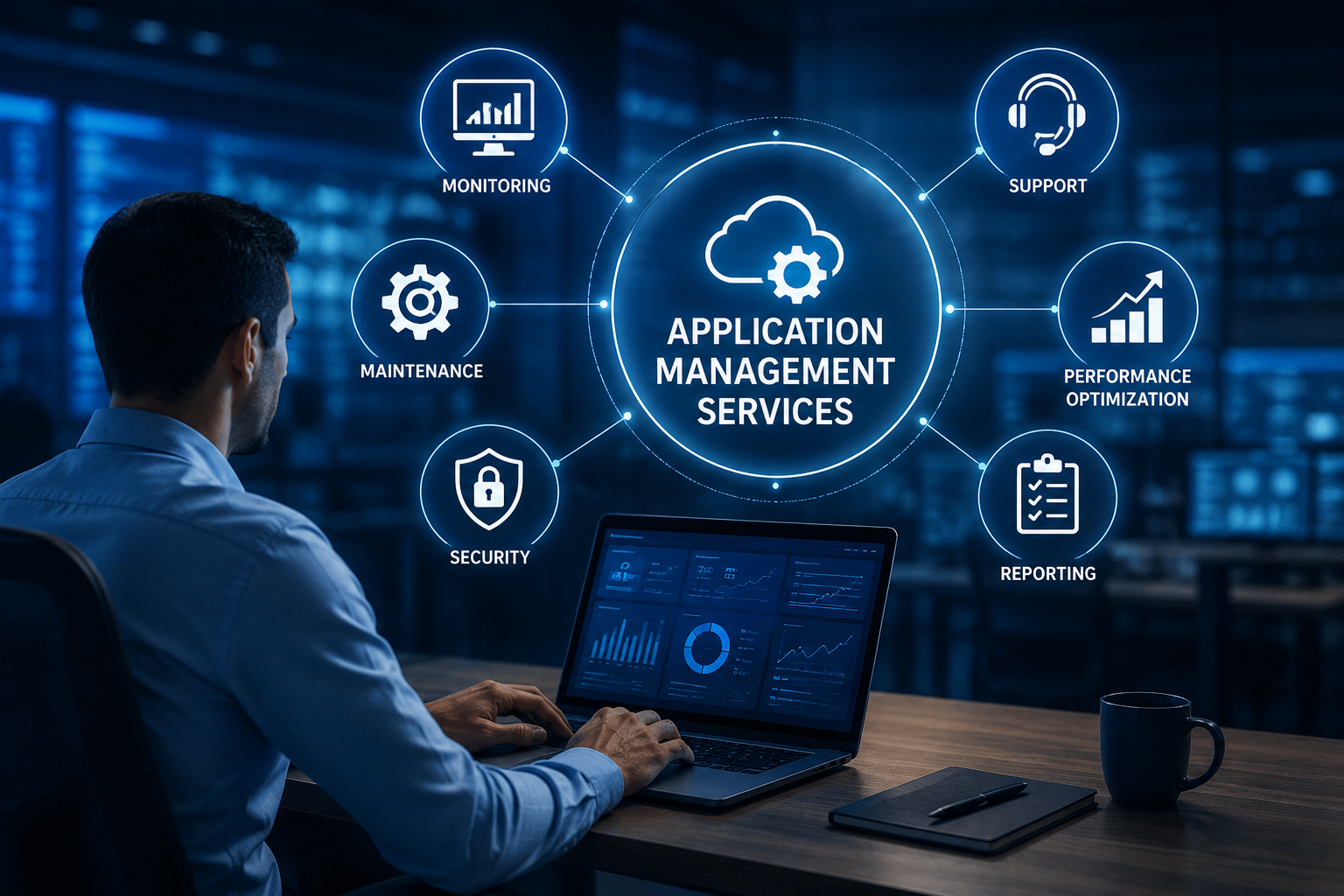
The type of activities that are covered by Application Management Services can vary widely depending on an organization’s needs. Shared services involve incident management, technical support, performance tuning, maintenance, application monitoring, security support, user support, upgrades, and support.
Monitoring can be done to detect application problems before it is serious. Support teams will research the technical issues and offer solutions for users that may be having trouble.
Maintenance helps to keep applications compatible with operating systems, databases, infrastructure, and other technologies. Application enhancements may contain new features, security fixes, and fixes for identified technical issues.
Application Development and Customisation could be part of the AMS. Occasionally businesses have to have an existing application that needs to be adjusted to accommodate new workflows, integrations, or business needs.
Why Do Businesses Need Application Monitoring to Enhance IT Performance?
Application monitoring plays a crucial role in efficient Application Management Services. It’s about constantly monitoring application performance, availability, resource usage, and other technical metrics.
If no monitoring is performed, problems may only be identified by a member of the staff or a customer. If the process is carried out proactively, the monitoring team is able to discover unusual activities and investigate any issues at an earlier stage.
For instance, when an application starts to use a disproportionate amount of system resources, an AMS team can conduct an investigation prior to a major outage. Likewise, performance patterns can identify capacity issues that could lead to changes in infrastructure. Monitoring can help ensure the application is more reliable and enable organizations to offer a better experience to their employees and customers.
What Can AMS Do to Enhance Application Security?
Security in application development is a crucial issue for any cutting-edge organization. Applications typically handle confidential business, customer, financial, and employee data, which can be expensive if there are security vulnerabilities in the application.
Application Management Services can help with security by monitoring application environments and applying patches, identifying vulnerabilities, managing access controls, and keeping application configurations secure.
AMS teams can also be called to assist in responding to a security incident and in making the recommended moves to upgrade. It is especially critical to ensure that applications are kept up-to-date since legacy applications might have known vulnerabilities.
There should be clear delineation of responsibilities between the organization and the AMS provider, though. An appropriate policy for access, data protection, incident response and compliance should be created.
How Does AMS Support Cloud-Based Applications?
The deployment and management of applications have shifted with cloud computing. It can be public clouds, private clouds, hybrid clouds, or Software-as-a-Service applications. The performance and cost of cloud applications are affected by configuration, infrastructure, integrations and resource utilization, and require expertise to manage.
Application Management Services can support organizations in various areas including monitoring cloud applications, managing updates, troubleshooting technical problems, optimizing performance and coordinating integrations.
AMS providers can also assist businesses with identifying inefficiencies in the use of resources. Organizations can track application workloads and infrastructure needs to optimize performance and manage unneeded cloud costs.
How to cut IT Expenses with AMS?
Cost efficiency is among the primary factors that compel companies to look into Application Management Services. It can be costly to have a large in-house staff with an array of skills and experience in each application.
Businesses can take advantage of a service model that is hosted outside of AMS. Rather than having to hire specialists for each technology, organisations can rely on a specialist who is already knowledgeable and has the processes.
There are also cost savings to be had with unexpected application failures, which can be achieved through proactive maintenance. Downtime can impact employee productivity, customer satisfaction, sales and business operations. Moreover, there is also easier IT budgeting as the predictable service arrangements allow for creation of the defined support costs and the service expectations.
What are the Various AMS Delivery Models?
There are various Application Management Services types according to the technical requirements and capabilities of a business. Fully managed model. Relies on an external provider to handle a significant amount of application support and maintenance. It can be beneficial for companies looking to offload some of its internal IT workload.
The co-managed model is a mixture of internal employees and an external AMS provider. The internal team can be responsible for strategic decisions and the service provider can be responsible for specific technical duties.
A specialized model is one that is based on specific applications, platforms or services. It can be helpful if an organization has its own IT resources but requires specific expertise on certain technologies.
The best model for the application will vary depending on the complexity of the application, the needs of the business, budget, internal capabilities, and the level of external support required.
How to Select Application Management Services Provider?
When selecting an AMS provider, there is much to consider. The first step a business can take is to determine their applications and support needs. Think of the applications that are critical to the business, the technologies being employed, existing performance issues, the number of support hours to expect, the security needs and future growth plans.
Another consideration is experience. Seek out providers that have a proven track record of the technologies and industries your organization is interested in. SLA’s should also be checked. They need to be clear about response times, resolution goals, expectations in terms of availability, escalation procedures, reporting and responsibilities. But, communication is also key. A provider with good technical skills can be difficult to work with due to bad communication.
Before Outsourcing AMS, What Should You Consider?
Organizations should be aware of what they will be giving up to the provider before they go ahead and expect to outsource Application Management Services.
Develop a concise list of applications, systems, integrations, support processes and business critical workflows. Identify the need for ongoing in-house work and what can be outsourced.
A review of data security and compliance should also be done. It is important that the organization be aware of how the provider will be handling the business information including the methods used to access, store, process and protect business information.
Before the engagement, it’s also helpful to set performance criteria. The metrics are easier to use to assess whether the AMS provider is providing the desired value.
How can AMS help Business Scalability?
Another key benefit of Application Management Services is that they are scalable. As a business expands, the amount of application workloads may grow, new users can be added and other systems may be integrated.
The groups at AMS can help this expansion by keeping an eye on the capacity of the applications, improving their performance, implementing integration features and helping organizations in the deployment of new functionality.
When the business grows, organizations can implement flexible AMS capabilities that can grow as per the changing needs rather than rebuilding IT support structures. Whenever a company is experiencing rapid growth or a digital transformation, the Application Management Services come in handy.
What’s the Best Practices for AMS Success?
The key to a good AMS implementation is having well-defined goals. Businesses should decide what features are essential for their primary objectives of performance, minimizing downtime, cost optimization, security, quicker support, or scalability.
It’s also necessary to have documentation. The architecture of the application, dependencies, integrations, workflows and support procedure should be well documented.
Clarification of communication channels and escalation procedures should be outlined by the organization. Performance reviews can be used to determine areas for improvement on a regular basis.
Lastly, businesses should look at AMS as a long-term relationship and not a mere outsourcing contract. Appropriate ongoing interaction among internal stakeholders and the AMS supplier can help to keep application management in line with business goals.
What are the Typical Issues for Application Management Services?
While AMS has many benefits, there are likely to be some things that will be difficult for organisations to implement. Vague roles can lead to internal/external role confusion.
The other problem is lack of documentation. Troubleshooting for an application with an AMS provider might take longer if the provider does not have enough information about applications and dependencies.
Access management and security can also get complex when external parties need access to business systems. Organisations should have suitable permissions and monitoring in place.
Another key factor to take into account is change management. It is important to carefully plan application updates, migrations and changes in configuration to reduce disruption.
What Does the Future of Application Management Services Hold?
Continuous automation, AI, cloud and predictive analytics will likely become even more used to support future Application Management Services. Unusual application behavior and failures can be detected through the aid of AI-powered monitoring. There are some routine problems that can be addressed by automated workflows without the human touch.
Predictive maintenance can also help AMS teams to anticipate performance issues before they impact users. The growing use of cloud technologies and the adoption of modern application architectures will put even more pressure on the need for specialized application management skills. As businesses increasingly embrace digital technologies, AMS will focus more on business outcomes than on basic technical support.
What are the Main Advantages of Application Management Services?
Some of the major benefits of Application Management Services include enhanced application availability, quicker issue resolution, improved security, performance, access to expertise, predictable IT costs and scalability.
With proactive monitoring and technical support and a continuous improvement process, AMS can ensure businesses have reliable applications and can let internal teams concentrate on strategic priorities.
Commonly Asked Questions in Application Management Services?
Application Management Services Explained?
Application Management Services are expert IT services which assist organizations to monitor, maintain, support, secure, optimize and enhance their business applications.
Why do Businesses rely on AMS Providers?
Businesses rely on AMS providers to access their technical expertise, enhance application reliability, lessen support burdens, manage cost, and ensure critical application reliability.
Will AMS Support Cloud Applications?
Here are some of the ways that AMS providers can help with cloud-based applications: Cloud application monitoring, troubleshooting, performance optimization, maintenance, security support and integration management.
Does AMS Work for Small Businesses?
AMS may be employed by small and medium-sized businesses to gain access to technical expertise while not having to keep a large internal application support team.
What is the Cost of Application Management Services?
Prices are dependent on the complexity of the application, the number of applications, the required support, technology platforms, service hours, and the chosen delivery model.
Is it Possible for AMS to Improve Application Security?
AMS can be used to help manage application security: patch management, monitoring, vulnerability management, secure configuration, access control and incident response processes.
How to Choose an AMS Provider?
When you’re deciding on a provider, you need to take into account technical knowledge, industry experience, service level agreements, security measures, scalability, communication and support, pricing, and references.
Conclusion
Application Management Services offer a structured approach to managing, maintaining, securing and optimizing important applications for businesses. Whether it’s monitoring and troubleshooting, cloud support, security upgrades, performance optimization, or scalability, AMS can help organizations establish a more dependable IT environment.
The best AMS model for an organization is determined by the type of application used, in-house knowledge, business objectives, budget and long-term technology investment. The right provider can be chosen, clear responsibilities can be set, measurable service levels can be set, and effective communication can be kept to make application management a strategic asset.